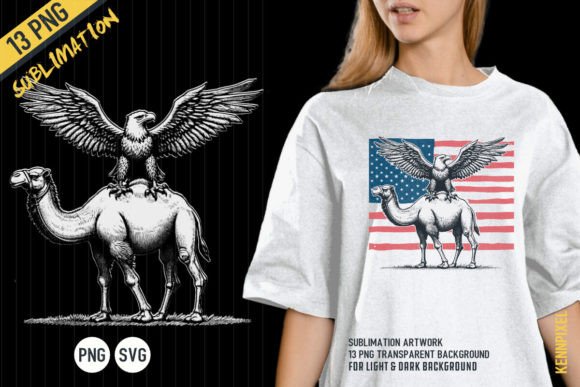
Camel and Eagle Retro Shirt: A Designer’s Review
As a designer who spends half my life staring at stitch maps and the other half trying to sell what I create, I don’t just look for "pretty pictures." I look for viability. When a new machine embroidery design lands on my desk, I’m immediately thinking about hoop size, fabric stability, thread contrast, and whether this piece will actually hold up after twenty washes in a customer’s machine. Today, I’m putting that lens on the Camel and Eagle Retro Shirt. This isn’t just another clip-art download; it’s a specific aesthetic choice with real-world implications for your craft business or personal projects.
The First Impression: Mood and Visual Personality
The moment you unzip the file containing the 14 assets of the Camel and Eagle Retro Shirt, the vibe hits you. It’s not minimalist. It’s not overly delicate. It carries a heavy, nostalgic weight—a classic Americana or vintage travel poster feel. The juxtaposition of the camel and the eagle suggests adventure, ruggedness, and perhaps a touch of whimsy. For an embroidery project, this visual personality is crucial because it dictates where the design belongs.
This isn’t a design for a delicate lace doily or a sheer chiffon blouse. It screams for structure. It feels right at home on heavyweight cotton, denim, or canvas. The retro theme implies bold lines and distinct shapes, which translates beautifully to embroidery when the digitization is done correctly. You can already imagine this as a statement piece on a sweatshirt embroidery project or a standout graphic on a tote bag design for a farmer’s market booth.
Real-World Application: From Screen to Stitch
Let’s talk about how this design performs when we move from the digital preview to the physical embroidery project. I recently considered using a similar layout for a batch of custom aprons for a local coffee shop client. The bold nature of the Camel and Eagle Retro Shirt graphics works exceptionally well in that context. It reads clearly from across a room, which is essential for branding.
However, the transition from Graphics to textile requires careful planning. The design includes high-resolution PNGs and vector shapes, giving you flexibility, but the final result depends entirely on your execution. If you are an Etsy seller looking to list this as a small shop product, you need to consider the end user. Who is buying this? Likely someone who appreciates outdoor themes, vintage aesthetics, or unique handmade gifts. The design has strong appeal for holiday gifts, particularly around autumn or winter holidays where rustic themes dominate.
I also see this working beautifully as an embroidered patch to be sewn onto a denim jacket or a backpack. The retro style lends itself to the "worn-in" look that many fashion enthusiasts seek. It adds character without being too trendy, ensuring the finished product remains relevant longer than a fad-based design.
Where to Exercise Caution
No design is perfect for every surface. While the Camel and Eagle Retro Shirt has a strong presence, there are specific scenarios where it might struggle. First, avoid small hoop sizes unless the design is simplified. Embroidery machines have limits on how much detail they can resolve in a tiny space. If the intricate details of the camel or eagle get lost in a dense cluster of stitches, the design loses its charm and becomes a muddy blob.
Second, think about your fabric texture. This design relies on clean lines and solid blocks of color (if using fill stitches). On highly textured fabrics like bouclé wool or thick chenille, the definition of the shapes may be obscured. Similarly, on stretchy knits, you risk distortion if you don’t use the correct stabilizer. The retro style often implies a structured look, so stretching the fabric during stitching can ruin the intended aesthetic.
Dark fabrics present another challenge. If you plan to embroider this on black or navy, ensure your thread colors provide enough contrast. Light pastel threads might disappear against dark backgrounds, while bright neons might clash with the vintage mood. Always test your thread colors on scrap fabric first. Additionally, be mindful of dense stitch areas. If the design has large fill sections, ensure your machine can handle the density without breaking needles or causing puckering.
Impact on Product Value and Branding
Using a well-chosen design like the Camel and Eagle Retro Shirt elevates the perceived value of your handmade product. Customers associate quality with attention to detail. When they see a crisp, well-executed retro graphic, they assume the rest of the garment is made with care. This builds customer trust and encourages repeat business.
For commercial embroidery businesses, versatility is key. This design fits into multiple categories: custom apparel, baby embroidery (if scaled appropriately for onesies or blankets), and holiday embroidery. Its broad appeal means you aren’t limiting your market to a niche audience. Instead, you’re tapping into a wider demographic that enjoys nostalgic, nature-inspired art.
Furthermore, the inclusion of SVG files allows you to scale the design for different applications. You might use a smaller version for a chest pocket placement on a cap and a larger version for the back of a sweatshirt. This scalability enhances the utility of the digital embroidery file, making it a better investment for your design library.
Practical Notes for the Embroidery Designer
Before you hit the start button, here is my checklist for working with this design:
- Test on Scrap Fabric: Never go straight to your final garment. Stitch the design on a piece of the same fabric type to check for tension issues and color clashes.
- Review Stitch Density: Look closely at the digitizing. Are the fill stitches too dense? Will they cause puckering? Adjust if necessary.
- Check Hoop Size: Ensure your machine’s hoop can accommodate the full width and height of the design without cutting off details.
- Inspect Small Details: Zoom in on the raster images. Are there tiny elements that won’t translate well to thread? Consider simplifying these in your software before stitching.
- Stabilizer Selection: Use a cut-away stabilizer for stretchy fabrics and a tear-away for wovens, depending on the final product’s needs.
- Licensing Confirmation: Even though the package includes various file formats, always double-check the license terms. Are you allowed to sell finished items? Is there a limit on the number of units?
- Black and White Mockup: Convert the design to grayscale in your editing software. This helps you see if the composition holds up without relying on color alone.
Final Verdict
The Camel and Eagle Retro Shirt is a robust, versatile asset for any designer’s toolkit. It brings a strong narrative to your embroidery project, whether you are creating a personalized gift for a friend or a best-selling item for your online store. Its retro charm resonates with buyers looking for something with soul and history.
By paying attention to fabric choices, stitch quality, and proper stabilization, you can transform this digital graphic into a tangible, high-quality finished product. It’s not just a shirt design; it’s a foundation for creative expression. For the savvy craft business owner, it offers a reliable way to produce goods that stand out in a crowded marketplace. Just remember: the magic happens in the details, so take your time, test thoroughly, and let the design speak for itself.